The Twist That Has to Be Earned and the Kind That Cheats
The twist is the crown jewel of crime fiction, the moment a reader lives for: the revelation that turns the whole story inside out, that makes you gasp and immediately want to start again from page one. When it works, there is nothing else like it. When it fails, there is nothing more infuriating, because a bad twist does not merely disappoint — it retroactively insults every hour you spent reading. The difference between the two is not luck or shock value. It is a matter of craft, and specifically of one principle that separates the twist that thrills from the twist that cheats: whether the author played fair.
What a twist is actually doing
A twist is not simply a surprise. Anything can surprise a reader — a meteor, a long-lost twin, a narrator who was a ghost all along. What distinguishes a genuine twist is that it recontextualises. It takes everything the reader has already experienced and reveals that it meant something other than they thought, so that the same events now read completely differently. The pleasure is not the shock itself but the sudden reorganisation of the whole story around a truth that was there the entire time.
This is why the best twists produce a very particular double reaction: astonishment followed instantly by recognition. "I didn't see it coming" collides with "but of course — it was right there." That second feeling is everything. It means the surprise was not pulled from nowhere but was hiding in plain sight, and the reader, on reflection, realises they had all the pieces and simply assembled them wrong. A twist that delivers only the first feeling, the shock, without the second, the recognition, is not a twist at all. It is just a swerve.
The principle of fair play
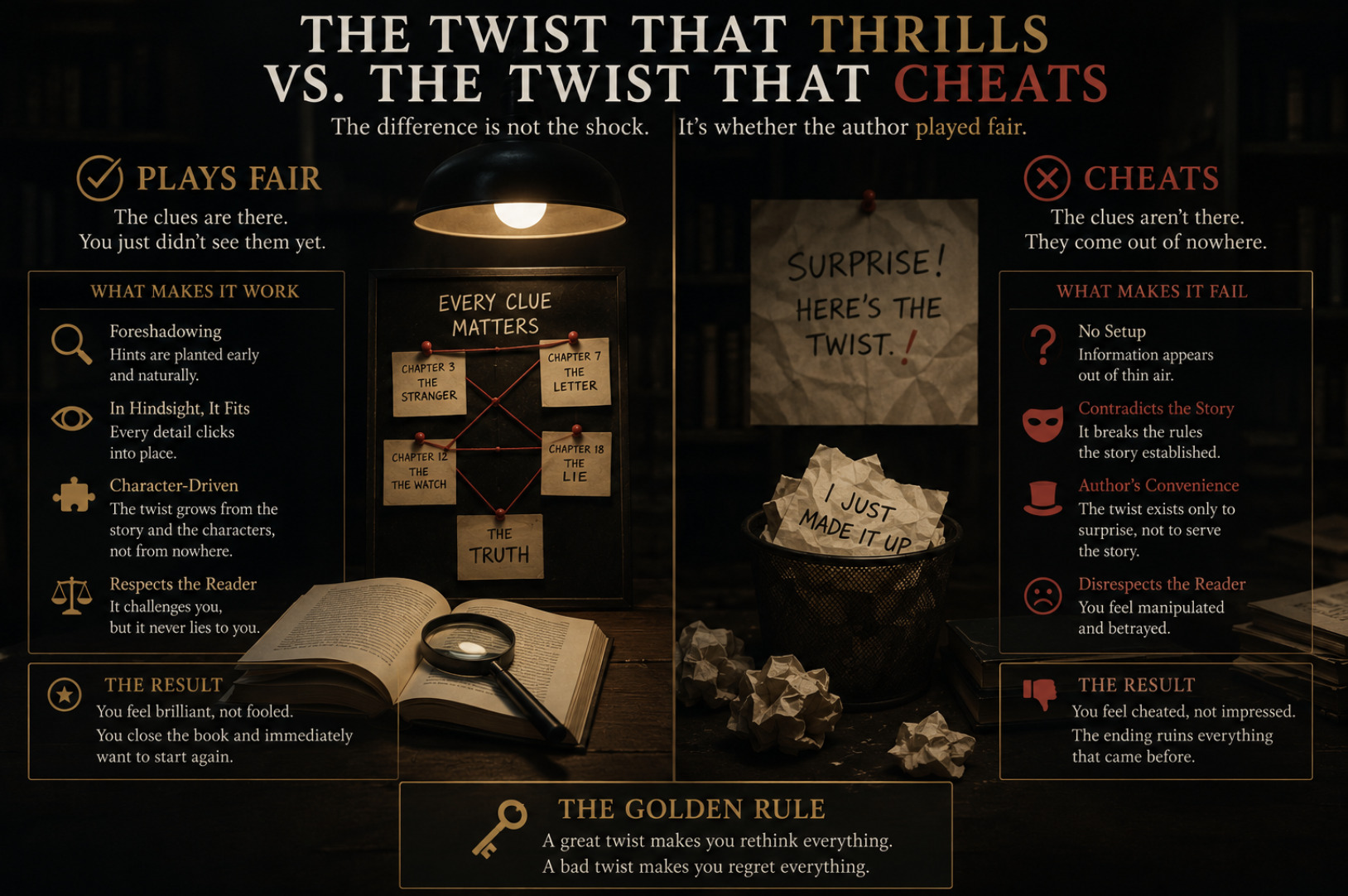
The rule that governs all of this is fair play, the oldest and most important contract in crime fiction. Fair play means the author must give the reader everything they need to arrive at the solution, even while working to ensure they do not. The clues are on the page, in plain sight, deliberately disguised — misdirected, buried in the ordinary, made to look like something else — but present. The reader loses the game not because information was withheld but because they were outmanoeuvred, and that is a loss they can respect and even enjoy.
The cheating twist violates this contract. It produces its shock by hiding a crucial fact from the reader, introducing a piece of information at the last moment that could not possibly have been deduced. The murderer turns out to be a character who was never meaningfully present; a secret motive appears that was never hinted at; a rule of the story's world changes in the final chapter. The reader feels cheated because they were cheated — not outwitted in a fair contest, but denied the chance to play at all. The art of the disguised clue, explored in the art of the red herring, is the honest version of this game; the last-minute reveal is the con.
Why the earned twist hits harder
It might seem that hiding information would make a twist more shocking, and in the crudest sense it does — you cannot guess what you were never shown. But that kind of shock is hollow and fades instantly, because there is nothing to reflect on. The earned twist, by contrast, keeps working after the reveal. Once you know the truth, you want to go back and watch the author pull it off, admiring the clues you walked past and the misdirection that fooled you. A fairly planted twist rewards rereading; a cheating one makes rereading pointless, because there was nothing there to find.
This is the deep reason fair play matters beyond mere etiquette. A twist built on planted clues is structurally sound: it holds up under scrutiny because the story was genuinely constructed to support it. A twist built on withheld information collapses the moment you examine it, because the story was not built to support the ending at all — the ending was simply dropped on top of it. One is a piece of architecture; the other is a trapdoor.
The unreliable narrator, done right
No device tests these principles more sharply than the unreliable narrator, one of crime fiction's most dangerous and rewarding tools. A narrator who lies to the reader can produce a magnificent twist — but only if the lie is fair, and the distinction is subtle. The narrator may deceive, may omit, may lead the reader astray through what they emphasise and what they pass over, yet a well-built unreliable narrator never states an outright falsehood the reader has no way to catch. The deception lives in interpretation and selection, not in fabrication, so that on rereading the reader sees the truth was always sayable between the lines.
This is the razor's edge that separates a brilliant unreliable narrator from a cheat, a tension we get into in the narrator who lies. Done right, the reveal that a narrator misled us feels like a fair trick beautifully executed. Done wrong — a narrator who simply lied about facts the reader could never have questioned — it feels like the author reaching through the page to rig the game. The device does not excuse the withholding; it only makes the fair version more spectacular and the cheating version more galling.
Earning the ending
In the end, a twist is a promise about the whole book. It tells the reader that the hours they invested were building toward something real, that the author was in control the entire time, and that the story means what it turns out to mean. Honour that promise and the reader forgives almost anything; break it and no amount of shock can compensate, because the pleasure of crime fiction depends on trusting that the game is fair. This is bound up with the larger question of what an ending owes its reader, which we took up in the ending that crime fiction owes you.
The twist that has to be earned is harder to write, precisely because it demands that the author hide the truth in full view and trust the disguise to hold. But it is the only kind worth writing, because it is the only kind that survives the reader turning back to the first page. A cheap twist wins a single gasp and loses the book. An earned one wins the gasp, the reread, and the reader's lasting respect — which is the difference, in this genre above all, between fooling someone and outplaying them.